
Prime Minister Modi will hold in-person meetings with President Putin for 8-9 hours during his nearly 24-hour stay in Russia, they said.

Lack of clarity over long-term commitments by states for buying RE acting as a dampener.
M&M was the biggest gainer in the Sensex chart, rising 6.51 per cent, followed by NTPC, PowerGrid, SBI, HDFC Bank, Asian Paints and Wipro. In contrast, Axis Bank, ITC, HUL, Nestle India and Sun Pharma were among the laggards.

'A 20 per cent equity allocation to ESG funds is a good start.' 'As more evidence on ESG performance builds, investors may increase allocations.'

Modi held a "productive meeting" with his Ethiopian counterpart Abiy Ahmed Ali on a day when BRICS (Brazil, Russia, India, China and South Africa) leaders officially endorsed Ethiopia's entry into the bloc.

Any government support or incentive to help exporters deal with high freight and insurance costs is unlikely.

Equity benchmark index Sensex on Wednesday crashed over 900 points to sink below the 73,000 level due to widespread selling pressure amid a sharp fall in smallcap and midcap indices. Besides, deep losses in utility, energy and metal stocks and recent selling by foreign investors added to the gloom, analysts said. Benchmark indices started the session on a positive note, but the selling intensified during afternoon trade, with all sectoral indices ending in the red.

'China is struggling to get out of its property bubble.' 'Japan took 35 years to walk out of its equity bubble.' 'Bubbles can be difficult to forecast.'
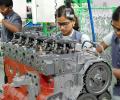
Genset manufacturer Cummins India has seen its share price rise by 45 per cent in the past three months. The management has reaffirmed that growth would be in double digits over the coming two fiscal years. Growth is expected to be driven by a pickup in domestic infrastructure spending.

Prices may go up because of higher energy costs, caused by the rise in shipping charges, with commercial vessels taking a longer route to avoid the troubled Red Sea region, the finance ministry said on Monday. Iran-backed Houthi rebels of Yemen are repeatedly attacking ships in the Red Sea. While the global economy is grappling with challenges such as sticky inflation, sluggish growth, and mounting fiscal pressure, India's external sector could face "potential risks" due to the ongoing geopolitical tensions, according to the finance ministry's report on the review of the Indian economy.

India had invited United States President Joe Biden to grace the occasion but he expressed inability to travel to New Delhi in January.

An ongoing debate on inter-relationships among trade/investment, energy and environment, its footprints on environment and climate and quality of energy business in terms of natural environments in countries exporting environmental goods and energy services in the context of producers and consumers of a variety of energy resources viz carbon, hydrogen and renewable across the globe, including developing and transition economies, has already taken a significant shape.

What stood out in his 15-year journey as a member of the political executive at the Centre was his glowing record as India's most successful and effective finance minister. Both as prime minister and finance minister, he understood the importance of gradualism, except when the economy or the polity was in a crisis.

The National Security Strategy document should flag all major issues concerning security strategy and provide guidelines to concerned departments to work out suitable action plans. Since the global and regional geopolitical canvas is dynamic, the NSS document should be deliberated at length before formulation and should be reviewed periodically, recommends Commodore Venugopal Menon (retd).

Investors lost around Rs 1.57 lakh crore in market valuation on Friday.

'2019 was fought on delivery. But in 2024, you can see the before and after effects.'
India on Monday announced the results for the country's first critical mineral auction. Amid the tepid response from big players, the list of successful bidders included some lesser known names. A total of five companies secured bids for six critical mineral blocks of graphite, manganese, phosphorite, lithium, and rare earth elements with auction premiums ranging from 13.05 per cent to 400 per cent.

US had made similar complaint against India in February.

Among the Sensex firms, Nestle rose the most by 4.66 per cent. NTPC rose by 2.16 per cent, Reliance Industries by 1.53 per cent, State Bank of India by 1.04 per cent and Hindustan Unilever by 1.03 per cent. ITC, Power Grid and Bajaj Finance were the major gainers. Wipro, Tata Consultancy Services, HCL Technologies, Tata Steel, Bajaj Finserv and Maruti were among the laggards.
Stock market investors became poorer by Rs 8.30 lakh crore as equities continued their slide for the sixth consecutive day on Friday. The BSE Sensex has tumbled 1,855.58 points or 3 per cent since February 16. During this period, the combined market capitalisation of BSE-listed firms has tanked Rs 8,30,322.61 crore to reach Rs 2,60,00,662.99 crore. "The domestic market is broadly demonstrating a lack of confidence, registering its sixth consecutive day of losses despite global markets turning green.

Among the Sensex firms, State Bank of India, Infosys, Titan, Tech Mahindra, IndusInd Bank, NTPC, ICICI Bank, Power Grid, Reliance Industries and Kotak Mahindra Bank were the major laggards. On the other hand, Tata Motors, Nestle, Hindustan Unilever, Tata Steel, Bajaj Finance and UltraTech Cement were among the gainers.
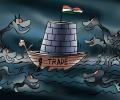
Indian exporters shipping goods to Israel may face higher insurance premiums and shipping costs due to the Israel-Hamas conflict, according to experts. Israel witnessed a surprise and unprecedented multifront attack by air, land and sea by the Hamas militant group, which rules the Gaza Strip, in its southern parts on Saturday morning. The International trade experts said the conflict may reduce the profits of domestic exporters but will not impact trade volumes unless war escalates.
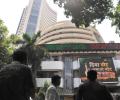
After a positive opening, the 30-share BSE Sensex suddenly faced selling pressure in late-afternoon trade. It finally settled just 5.67 points, or 0.01 per cent, lower at 39,586.41.

The ongoing Hamas-Israel conflict has disrupted India's efforts to gain from a recent fall in crude oil prices. Since Hamas' invasion of southern Israel on October 7, petroleum has become costlier by around $5 per barrel, threatening to stoke prices and impact growth. Brent crude was trading at $89.8 per barrel on October 9 (9.15 pm IST), up over 4 per cent, thwarting India's anticipation of a period of declining oil prices - after the leading global petroleum benchmark declined by around 11 per cent last week.

ONGC was the top gainer in the Sensex pack, rallying around 6 per cent, followed by IndusInd Bank, L&T, UltraTech Cement, Titan, SBI and NTPC. NSE Nifty settled 32.10 points up at 14,707.80.

The index is currently trading at 149 per cent of its historical P/B valuation, surpassing its previous peak of 125 per cent made in 2020-21.

The S&P BSE Sensex has gained 149 points to open at 25,802.
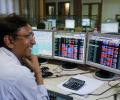
The market capitalisation of BSE-listed companies soared to an all-time high of Rs 406.52 lakh crore on Monday thanks to a rally in equities where the BSE Sensex climbed over 1 per cent. The 30-share BSE Sensex rallied 941.12 points or 1.28 per cent to finish at 74,671.28. During the day, it zoomed 990.99 points or 1.34 per cent to 74,721.15.

Bengaluru-headquartered IT services major Wipro Limited on Thursday announced that it has signed an agreement to acquire Capco, a global management and technology consultancy to the banking and financial services industry, for USD 1.45 billion.

RIL was the biggest gainer in the Sensex pack, rising 2.63 per cent, followed by NTPC, Axis Bank, Tata Steel, PowerGrid, HDFC twins, Bharti Airtel, M&M, ICICI Bank, SBI and Bajaj Finance -- gaining up to 2.51 per cent.

Asserting that there was growing scourge of terrorism in view of fast growing linkages of terrorist groups across the globe, India on Tuesday strongly advocated stepped up cooperation through intelligence exchange and training with 54 African countries.

Interim Budget, the US Federal policy decision and quarterly earnings will be the major drivers for stock markets which may also see some consolidation this week, say analysts. Besides, investors would also focus on the trading activity of foreign investors and global trends for further cues. From the macroeconomic front, the PMI (Purchasing Managers' Index) data for the manufacturing sector is scheduled to be announced on Thursday.

In the Sensex pack, index heavyweight Reliance Industries fell 2.84 per cent to Rs 1,057.15 after reports that the company's oil assets may take a hit due to the government's imposition of cost controls on soaring petrol and diesel prices.

The relationship between the US and India has been very productive, in particular on the trade and technology front, and 2023 can be considered the best year historically for bilateral ties, according to a former top American trade official. Arun Kumar, an Indian-American, who served as the assistant secretary of Commerce for Global Markets and director general of the US and Foreign Commercial Service (USFCS) during the Obama administration, said this during an interview with PTI in Washington. "Looking back on 2023, it was a very productive year for the US-India relationship, by many accounts the best year historically," he said.

There is no direct impact of the Russia-Ukraine crisis on India in terms of bilateral trade but a surge in oil prices poses considerable risk to the economy, an analyst report said on Friday. International oil prices which have surged past $100 per barrel "pose risks to external stability and currency movement," a Bank of Baroda Economics Research report said. Russia has launched military operations against Ukraine, stoking fears of significant disruption in the region, including loss of life. The West is ramping up financial sanctions against Russia and support for Ukraine.

'We expect market consolidation and recommend buying during market dips.'

Trinamool Congress is the second highest recipient of political donations through electoral bonds.

The US Federal Reserve's interest rate decision, global cues, macroeconomic data announcements and the ongoing quarterly earnings are the major triggers that will dictate trends in stock markets this week, analysts said. Besides, the trading activity of foreign investors and the movement of global oil benchmark Brent crude will also be tracked. "All eyes are on the outcome of the US Federal Reserve meeting scheduled for November 1, particularly due to the multi-year high levels of the US bond yields.

The country must get its act on global alliances right in order to feed its fuel-hungry economy, points out Subhomoy Bhattacharjee.

Without naming India, S&P said it expects that in regions where inflation already exceeds targets, or which are vulnerable to capital flight, central banks will be forced to raise interest rates.
